Start here
Not sure what to fix? Start with the $97 checkup.
Written review. Prioritized fix list. 3 to 5 business days. No call needed.
Get the Checkup → Book a free 15-min call

Written review. Prioritized fix list. 3 to 5 business days. No call needed.
Get the Checkup → Book a free 15-min call
A written audit of your site, lead path, ad tracking, and follow-up gaps. Delivered in 3 to 5 business days. No call required.
Have questions first? Book a free 15-min call
Stop losing leads to slow websites and manual tasks. Start with the $97 Website and Workflow Checkup. Get $97 Checkup
Everyone’s talking about AI. Your LinkedIn feed is full of people claiming it changed their life. Half the tools you already use have slapped an “AI-powered” badge on their homepage. But when you sit down to figure out how AI actually helps your business, the answer feels surprisingly unclear.
That’s because most AI advice is written for tech companies or enterprise teams with dedicated staff. If you’re a small business owner wearing five hats at once, you need something different. You need to know which AI tools solve problems you actually have, and how to use them without spending three weeks learning a new platform.
This is where AI delivers the fastest, most obvious win for small businesses. If you spend any time writing emails to clients, creating social media posts, drafting proposals, or putting together website copy, AI writing tools can cut that time in half or more.
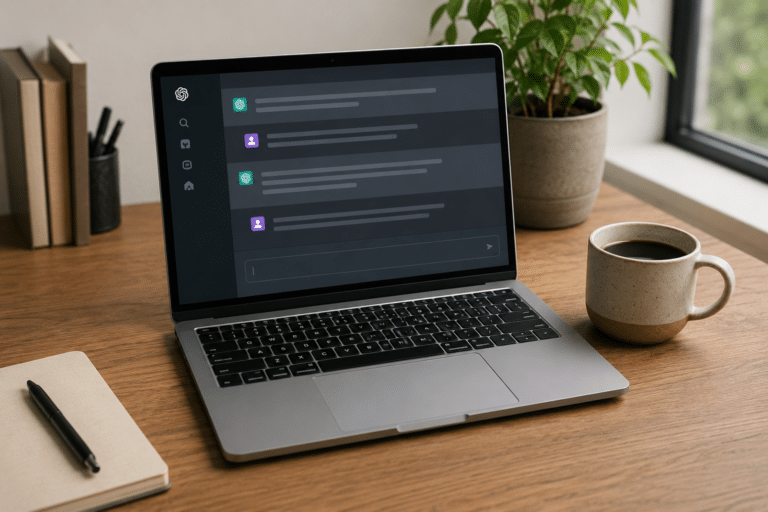
ChatGPT and Claude are the two heavyweights here. Both can draft emails, rewrite awkward paragraphs, generate social media captions, and help you outline blog posts. The key is giving them specific context about your business. Don’t just say “write me a social media post.” Say “write a casual Instagram caption for a local bakery announcing a new sourdough bread, targeting health-conscious customers in their 30s.” The more detail you feed in, the less editing you do on the other end.
For small business owners who need to produce content regularly but can’t afford a marketing team, this is a genuine game-changer. You’re not replacing your voice. You’re getting a first draft that’s 70% there, and then you polish it.
AI chatbots have gotten significantly better over the past year. Tools like Tidio and Intercom now offer AI-powered chat that can answer common customer questions, book appointments, and even process simple requests without you being involved.
If you’re a service business that gets the same ten questions over and over (“what are your hours,” “do you offer free estimates,” “what’s your turnaround time”), an AI chatbot on your website can handle those instantly. That means fewer interruptions during your workday and faster responses for potential clients, which directly affects whether they choose you or move on to someone else.
AI scheduling assistants like Reclaim.ai and Motion can look at your calendar, your priorities, and your tasks, then automatically schedule your day. They’ll move meetings when conflicts come up, protect focus time blocks, and make sure your high-priority work doesn’t get squeezed out by back-to-back calls.
This sounds small, but calendar management is one of those invisible time drains that eats hours every week. If you’ve ever spent 15 minutes going back and forth to find a meeting time, or realized at 4pm that you never got to the one thing you actually needed to do today, an AI scheduler solves that problem permanently.
Tools like QuickBooks and FreshBooks have added AI features that automatically categorize transactions, flag unusual expenses, and generate financial summaries. If you’ve been dumping receipts into a folder and dealing with it at tax time, these features turn a dreaded chore into something that mostly handles itself.
There are also AI tools specifically built for receipt scanning and expense tracking, like Dext and Fyle, that can pull data from photos of receipts and automatically match them to the right categories. For any business owner who’s ever lost a receipt or spent a weekend sorting through bank statements, this alone justifies the investment.
Canva’s AI features can now generate social media graphics, resize images for different platforms, and even create short videos from text prompts. If you’ve been paying a designer for basic social graphics or spending hours trying to make things look professional in PowerPoint, Canva’s AI tools get you 90% of the way there for a fraction of the cost.
For product photos, tools like Photoroom can remove backgrounds, add professional staging, and clean up images in seconds. If you sell physical products online, this saves a significant amount of time and money compared to traditional product photography.
The biggest mistake small business owners make with AI is trying to adopt too many tools at once. You read about fifteen different AI products, sign up for free trials on all of them, and end up using none of them consistently because the learning curve across all of them is too steep.
Pick one area where you’re spending the most time or losing the most money. Start with one AI tool that addresses that specific problem. Use it for at least two weeks before evaluating whether it’s working. Only then should you add a second tool.
The other trap is expecting AI to be perfect out of the box. It won’t be. AI-generated content needs editing. AI scheduling needs you to set preferences correctly. AI chatbots need training on your specific FAQs. The setup time is real, but it’s a one-time investment that pays off week after week.
A realistic AI-enhanced workflow for a small business owner might look like this: You use ChatGPT or Claude to draft your weekly newsletter and social posts on Monday morning, cutting a three-hour task to 45 minutes. Your AI chatbot handles the routine questions that come in throughout the week. Your scheduling tool automatically blocks focus time and handles meeting coordination. And your bookkeeping AI categorizes transactions as they come in, so month-end takes an hour instead of a full day.
None of that requires technical skills. None of it costs more than a couple hundred dollars a month total. And it frees up anywhere from five to fifteen hours a week that you can put back into the work that actually grows your business. That’s not hype. That’s just practical.
Two fixed-scope builds that fix both problems. No retainer to start. Live in under two weeks.