Start here
Not sure what to fix? Start with the $97 checkup.
Written review. Prioritized fix list. 3 to 5 business days. No call needed.
Get the Checkup → Book a free 15-min call

Written review. Prioritized fix list. 3 to 5 business days. No call needed.
Get the Checkup → Book a free 15-min call
A written audit of your site, lead path, ad tracking, and follow-up gaps. Delivered in 3 to 5 business days. No call required.
Have questions first? Book a free 15-min call
Stop losing leads to slow websites and manual tasks. Start with the $97 Website and Workflow Checkup. Get $97 Checkup
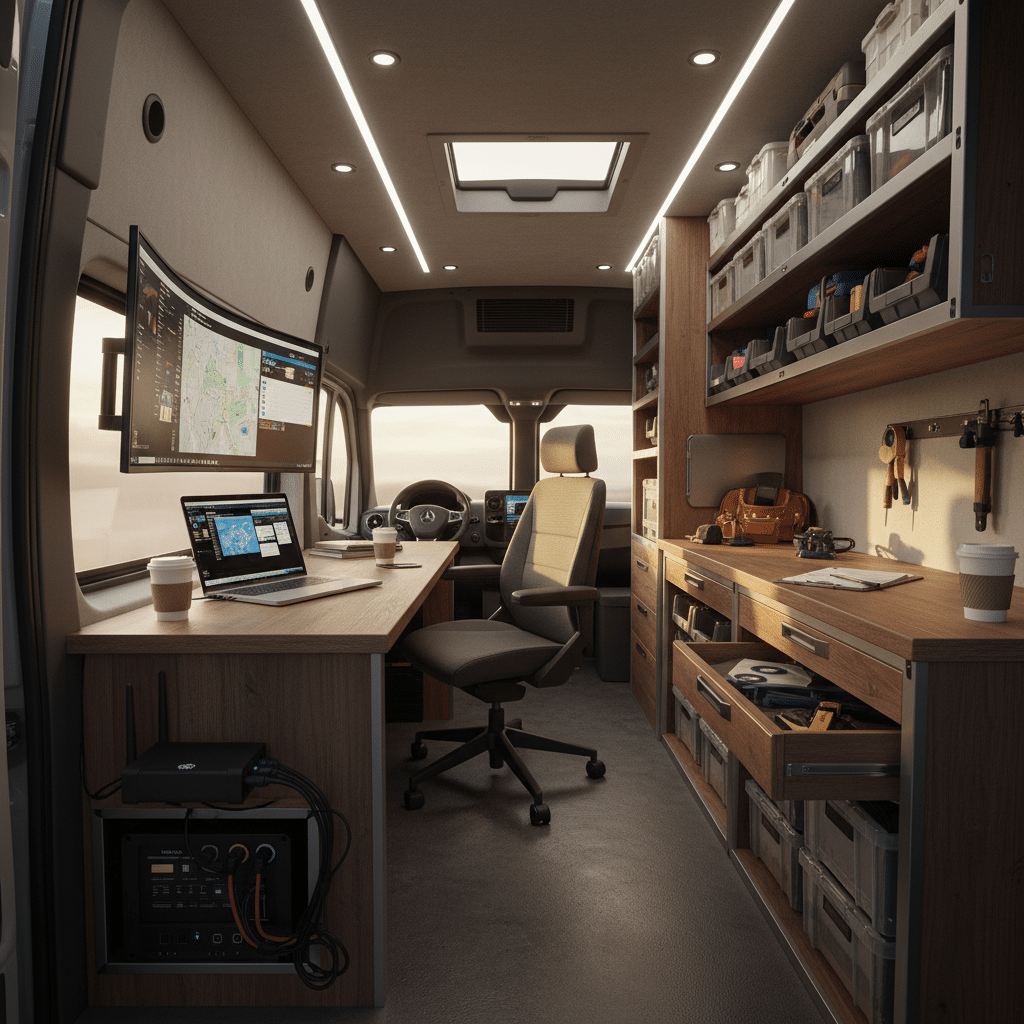
A Sprinter van becomes a very different asset the minute you stop seeing it as transportation and start seeing it as infrastructure.
That is the real shift. A lot of business owners look at a van and think delivery, service calls, or hauling gear. A smarter operator looks at that same space and sees a rolling office, a field coordination hub, a mobile sales station, a content production base, or a client support point that moves with the team. That difference matters because time gets lost in the gaps. The office is in one place. The job is somewhere else. The paperwork is on a laptop back at home. The customer wants an update now. The estimate gets delayed because somebody forgot a charger, a file, or a form. By the end of the week, a lot of “small delays” have quietly turned into a system problem.
That is why the mobile command center idea is bigger than the van itself. This is not really a vehicle article. It is an operations article.
The wrong way to build a mobile command center is to chase the coolest version of it. Big screen, fancy trim, dramatic lighting, sleek shelving, all the gear, all the visual flex. It might look great on video. It might also be a waste of money if the actual business workflow is still clumsy. A lot of people overbuild the shell and underbuild the system. They get excited about appearance and forget function. They spend money on how the van looks, then still rely on texts, screenshots, sticky notes, and memory to run the day. That is not a command center. That is a dressed-up mess.
The right way to think about it is simpler. What does the team need to do while moving between jobs or working in the field, and what currently slows that down? If you answer that honestly, the build gets a lot clearer.
Power usually comes first. If the van cannot reliably keep laptops, tablets, phones, routers, chargers, cameras, lighting, testing gear, or mobile printers running, you do not have a real working setup. You have a temporary setup that happens to be on wheels. Reliable power is not the glamorous part, but it is the part that separates a practical business asset from an expensive hobby. Same thing with internet. A lot of mobile teams do not need perfect enterprise-grade connectivity everywhere, but they do need a setup that lets them send estimates, upload notes, sync calendars, access job records, process payments, or communicate without playing tech roulette every afternoon.
After that, storage becomes the silent deal-breaker. People underestimate how fast a van can turn into a moving junk drawer if the storage is not built around real use. Cables end up in bags. Chargers go missing. Product samples get mixed with hand tools. Paperwork gets bent or lost. Devices slide around. Batteries die because there is no clean charging routine. When the physical setup is sloppy, the workflow gets sloppy too. One of the fastest ways to waste paid time is to make the team search for basic things in the middle of the workday.
But even that is still only half the picture. The real value shows up when the van connects cleanly to the business backend. That is where most small businesses either get this right or completely miss the point.
A field team that can pull up a customer record, log job notes, send an invoice, collect a deposit, trigger a follow-up, and notify the office without bouncing across six apps is operating from a real system. A team that still has to remember everything later, retype details at night, or wait until they get back to a desk is still dragging old friction around inside a nicer shell. The van can hold the tools, but the business still needs a digital flow behind it. This is exactly where websites, forms, CRM, automations, and follow-up systems stop sounding like abstract “tech stuff” and start looking like operational leverage.
That matters a lot for service businesses. If you run HVAC, cleaning, detailing, home repair, photography, events, inspection, mobile beauty, catering, AV support, or any business where work happens away from a fixed office, the field is where a lot of customer experience gets won or lost. The client does not really care whether your team has a cool van. They care whether communication is clear, estimates are fast, payments are easy, updates happen on time, and follow-through feels organized. That experience is built by systems, not just cabinetry.
It matters for creators too, especially teams working on location. The creator economy has made a lot of people think in terms of cameras, lights, and editing software, but not enough of them think about workflow. Where are raw files going? How are approvals being handled? What happens if you need to send content quickly from the road? How are leads or client inquiries being captured while the team is filming? A mobile creator setup that only solves shooting and not the business side is incomplete.
There is also a sales angle here that people miss. A van can function as a mobile trust signal if it is built correctly. Clean branding, clear systems, a professional experience on-site, easy forms, fast proposals, clean invoicing, and quick next steps all reinforce the same message. This business knows what it is doing. A sloppy van with a weak digital process sends the opposite message, even if the work itself is good. In small business, that gap matters. Trust is often built in little moments. How fast the estimate comes in. Whether the invoice looks clean. Whether the scheduling flow feels easy. Whether the follow-up feels intentional. A mobile command center helps when it supports those moments instead of just decorating them.
That is why I think the best mobile setup decisions usually come from asking workflow questions before build questions. What jobs happen on the road. What decisions need to be made in the field. What information gets lost most often. What causes back-and-forth with customers. What keeps getting delayed until later. What gets duplicated. What needs to sync back to the office. What could be handled immediately if the system were tighter. Those answers tell you what the van actually needs. Otherwise you end up building around a fantasy version of your business instead of the real one.
There is also a budget lesson here. A lot of owners assume a mobile command center has to mean a huge build with a huge price tag. Sometimes that is true for complex setups. A lot of times it is not. A more practical path is to build in layers. Start with power, connectivity, secure device storage, and a stable workflow. Then improve from there. I would rather see a business run a simple, reliable setup tied into a strong CRM and form process than blow money on a dramatic build while still losing leads because nobody tightened the digital side. Fancy does not always mean effective. That is true for vans, websites, stores, and pretty much every business system.
The strongest version of this idea is not “look how futuristic our van is.” It is “look how much cleaner and faster our field operations now run.” Faster estimates. Better records. Cleaner communication. Less missed follow-up. Less duplicate work. More trust. More jobs closed. Better handoff between the road and the office. That is where the ROI comes from.
So yes, a Sprinter van can become a mobile command center. But the van itself is not the point. The point is building a working field system around real business friction. The physical build is the visible part. The workflow is the valuable part.
PTE currently offers custom websites, AI chatbot integration, CRM and workflow automation, ongoing support, free quotes, strategy calls, and a $97 Website and Workflow Checkup. If your team works in the field, the van is only half the setup. The backend matters just as much.
Two fixed-scope builds that fix both problems. No retainer to start. Live in under two weeks.