


 FREE + PRACTICAL
Join Practical Tools Explained and get practical website and automation tips that help small businesses capture more leads, follow up faster, and waste less time on manual work.
No fluff. No spam. Just useful advice for small business owners who want better systems and more revenue.
Stop losing leads to slow websites and manual tasks. Get a complete Website and Workflow Checkup for just $97. Start Here→
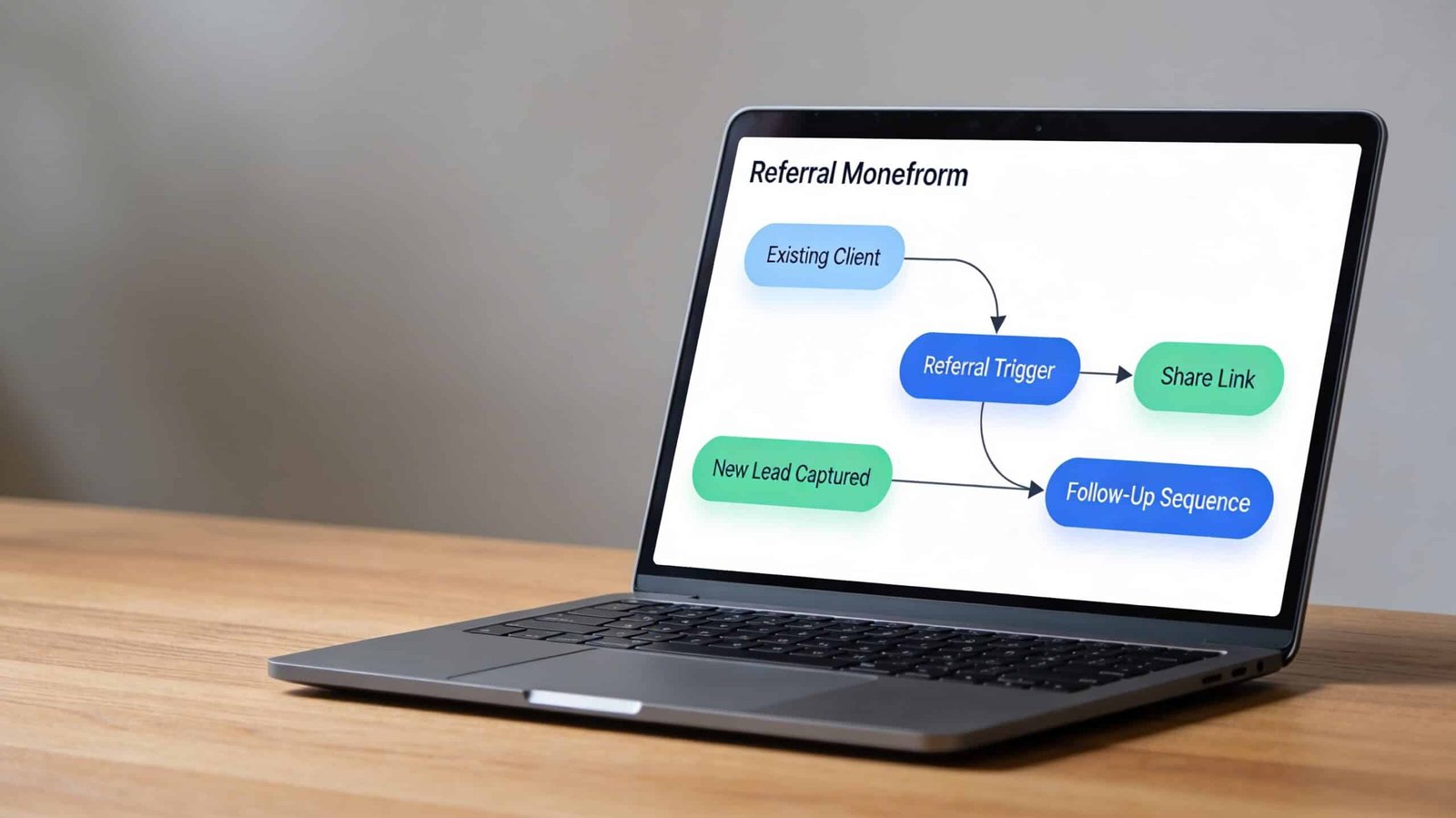
Referrals are the highest-converting lead source for most service businesses. The close rate on a referred lead is typically three to five times higher than a cold lead, the sales cycle is shorter, and the client tends to be better qualified because someone who knows your work vouched for you before the conversation started. Most business owners know this. Most business owners also handle referrals entirely reactively, meaning they wait for them to arrive rather than building a system that generates them consistently.
The gap between knowing referrals matter and actively engineering them is usually a combination of two things. The first is not wanting to seem pushy by asking. The second is not having a reliable process for asking at the right moment. Both of those problems are solvable with a well-designed automated workflow that removes the awkwardness from the ask and ensures it happens consistently without depending on you to remember to do it.
The Right Moment Matters More Than the Ask Itself
The timing of a referral request determines most of its outcome. Asking for a referral during the sales process, before you’ve delivered any value, produces almost nothing. Asking in a generic annual email to your entire client list produces very little. Asking at a moment when the client has just experienced a clear win produces referrals.
That moment is different for every type of service business, but the pattern is consistent. It’s the moment when the client can feel the value of what you delivered, not just understand it abstractly. For a web designer, it might be when the site goes live and the client sees it for the first time. For a bookkeeper, it might be when a client’s financials are cleaned up and they see the clear picture for the first time. For a consultant, it might be when a specific outcome has been reached that was part of the engagement’s stated goal.
Your first task before building any automation is identifying the two or three specific trigger moments in your client journey where satisfaction tends to peak. These are the moments your automated referral ask should be tied to. Not a calendar date. Not a project phase. A specific event that signals value has been delivered.
Mapping the Automated Referral Workflow
Once you know the trigger moments, the workflow is straightforward to build. When a specific event occurs in your project management or CRM tool, a sequence of automated actions fires. Here’s what a working version of that workflow looks like in practice.
A project is marked complete in your project management tool. That status change triggers an automation in Make or Zapier that updates the client record in your CRM and initiates a post-project sequence. The first message in that sequence goes out within 24 to 48 hours of project completion. It’s a short, direct email that acknowledges the completion, names something specific about the work, and asks a clear question: “Is there anyone in your network who might benefit from something similar?” One question. No formal referral program language. No incentive mentioned yet. Just a direct, personal-sounding ask at the moment when the relationship is at its warmest.
That email is where most referral systems stop, and most referral systems plateau for that reason. The workflow should continue whether the client responds or not.
If the client replies positively or makes an introduction, the workflow routes that to your CRM as a new lead with a referral tag and a task to follow up within 24 hours. If the client doesn’t respond within five days, a second short message goes out. Not a repeat of the first. Something different in tone, maybe a resource, a case study, or a piece of useful content related to their industry, that keeps the relationship warm without repeating the ask immediately. Seven days after that, a final soft check-in that includes a more structured referral ask, this time with a specific incentive if you’re offering one, such as a credit toward future work or a charitable donation in their name.
The key design principle here is that the sequence is triggered by an event, not by a date. It fires because something meaningful happened, not because a calendar entry said it was time to check in. That event-based logic is what makes the outreach feel timely rather than random.
Building It Without Custom Development
The tools required for this workflow are ones most service businesses already have or can access at low cost. A CRM with automation capability, HubSpot, Pipedrive, or ActiveCampaign all work, handles the email sequence and the lead routing. A project management tool that can trigger external automations via Zapier or Make, tools like Asana, ClickUp, Notion, and Monday all support this, handles the event detection. The connection between the project management tool and the CRM is a simple Zapier automation that takes about 20 minutes to configure.
If your project management tool and CRM are the same platform, the trigger and the sequence live in one place and require no middleware. HubSpot’s deals and sequences, for example, can handle the entire workflow natively if your project completion is tracked as a deal stage change.
The email content in the sequence is the piece that requires the most thought and the least technical work. Write each email as if you’re sending it manually to a single client you know well. Use their name through personalization tokens. Reference specifics about their project where the automation allows dynamic content insertion. Keep each message under 150 words. The shorter and more specific the message, the more it reads as a genuine personal note rather than an automated sequence, which is precisely the tone you want for a referral ask. This same principle applies to your broader lead nurturing approach, where keeping brand voice intact inside automation is what separates sequences that convert from sequences that get ignored.
Adding Structure for Higher-Volume Referral Generation
Once the basic post-completion sequence is running, a secondary layer worth adding is a lightweight formal referral program for clients who are consistently high-value referrers. Identify which clients have already referred others organically, which tends to be a small number across most service businesses, typically 10 to 20 percent of your client base generates the majority of referrals. These clients already want to refer you. Making it easier and more rewarding for them to do so is entirely mechanical.
A simple referral page on your website with a unique tracking link for each top-referrer, combined with a small reward structure, formalizes something that’s already happening and gives your best advocates a cleaner way to send people to you. The tracking link can be generated through your CRM or through a lightweight referral tool like ReferralHero or Rewardful, both of which integrate with common CRMs and email platforms and handle the tracking and reward fulfillment automatically.
The page itself doesn’t need to be elaborate. A short explanation of what you do, who makes a good fit as a client, a link to share, and what happens when they refer. Specificity about who is a good fit is one of the most underused elements of referral program design. When your advocates know exactly what kind of person to refer, the quality of referrals improves significantly over generic “anyone you know” language.
Keeping the Engine Running
The automated referral engine requires very little ongoing maintenance once it’s correctly configured. The main maintenance tasks are reviewing the email content quarterly to ensure it still reflects your current positioning, checking that the CRM automation is correctly tagging and routing referred leads so you can track the program’s output, and periodically reaching out personally to your top referrers to thank them and keep that relationship warm in a way that automation alone can’t replace.
Referrals generated by a well-timed automated system don’t feel less genuine to the recipient. The introduction still comes from a trusted person. The ask that prompted it was relevant and well-timed. The lead that arrives still has the credibility of a referral relationship behind it. The only thing that changed is that the ask didn’t depend on you remembering to send it manually during a week when three other priorities were competing for your attention.
That reliability is the actual value of the automated referral engine. Not that it replaces the human relationship, but that it ensures the human relationship is consistently leveraged in a way that it rarely is when the process is left entirely to memory and intention.