Start here
Not sure what to fix? Start with the $97 checkup.
Written review. Prioritized fix list. 3 to 5 business days. No call needed.
Get the Checkup → Book a free 15-min call

Written review. Prioritized fix list. 3 to 5 business days. No call needed.
Get the Checkup → Book a free 15-min call
A written audit of your site, lead path, ad tracking, and follow-up gaps. Delivered in 3 to 5 business days. No call required.
Have questions first? Book a free 15-min call
Stop losing leads to slow websites and manual tasks. Start with the $97 Website and Workflow Checkup. Get $97 Checkup
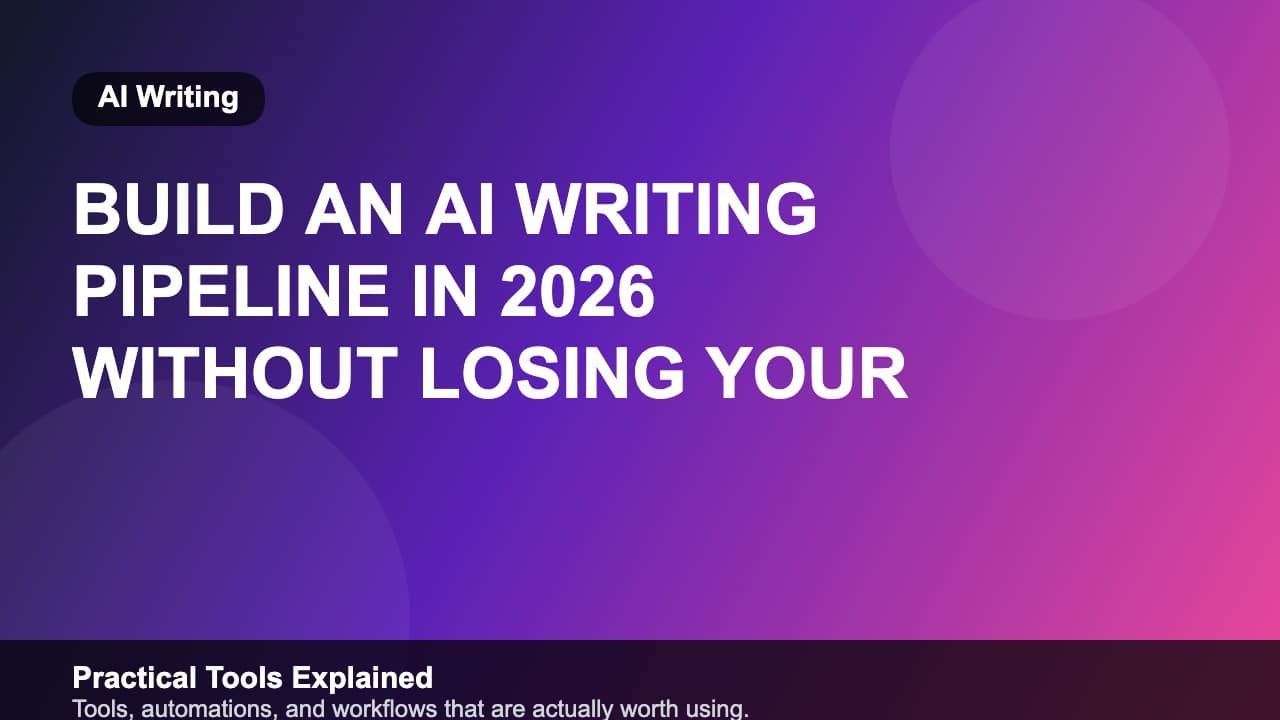
A step by step AI writing workflow that uses the right tools for ideas, drafting, and editing while keeping your voice and judgment in charge.
AI can help you write faster, but it can also flatten your voice if you hand it the keys. Most business owners bounce between chat windows, paste random prompts, and end up with copy that sounds nothing like them. The goal of a good AI writing pipeline is not to replace you. The goal is to remove the heavy lifting around blank pages, repetitive edits, and structural work so you can spend your energy on the parts only you can do.
Some links in this guide are affiliate links. I only recommend tools I actually use or would use in my own business.
In this guide we will build a simple 2026 AI writing pipeline that uses AI for outlines, idea expansion, and cleanup while you stay in control of the final words. You will use helper tools like those in this AI writing helper guide, plus lightweight rewriters such as your sentence rewriter and your paragraph rewriter to speed up editing without erasing your tone.
Break your writing process into three jobs: planning, drafting, and polishing. AI is best at planning and polishing. It is decent at drafting when you give it structure and specifics. It is bad at deciding what you should say in the first place and how you want to sound. That part stays with you.
During planning, you can use AI to generate topic variations, outline angles, and example questions your audience might have. For blog posts, start with a seed idea and ask AI for subtopics and reader questions. Then compare those to the themes in your content marketing guides so each piece ties back to a real offer or problem in your business.
For drafting, treat AI like a writing buddy, not a ghostwriter. You can feed it your outline along with two or three samples of your real writing and ask it to produce a rough first pass. Expect to edit heavily. The point is not to copy and paste the output. The point is to avoid staring at an empty document.
Once you have a draft, bring in focused helpers. Use the sentence rewriter on clunky lines and the paragraph rewriter on sections that feel muddy. These tools are good at smoothing language while you decide whether the meaning and tone still match what you want to say.
For long form content, you can use AI to check structure. Ask it to summarize each section in one sentence. If the summaries do not match what you thought you wrote, the draft is not clear yet. Adjust your headings and transitions so each section earns its place. The article on AI and content marketing has more examples of where AI can spot gaps in your message.
AI can also help with repurposing. Once you lock in a strong article, you can have AI propose social snippets, email angles, and video hooks based on the same core idea. Combine that with your existing systems in marketing automation with AI and you get far more mileage from each piece of content without feeling like you are rewriting everything by hand.
The key to keeping your voice is to give AI your voice on purpose. Feed it real samples, correct it when it drifts, and never publish anything you would not say out loud. Use AI to speed up the mechanics, not to make decisions about what your brand stands for.
This pipeline is not about cranking out a hundred generic posts a week. It is about taking the ideas and experience you already have and getting them onto the page and into your systems faster, cleaner, and with less friction.
Two fixed-scope builds that fix both problems. No retainer to start. Live in under two weeks.