Start here
Not sure what to fix? Start with the $97 checkup.
Written review. Prioritized fix list. 3 to 5 business days. No call needed.
Get the Checkup → Book a free 15-min call

Written review. Prioritized fix list. 3 to 5 business days. No call needed.
Get the Checkup → Book a free 15-min call
A written audit of your site, lead path, ad tracking, and follow-up gaps. Delivered in 3 to 5 business days. No call required.
Have questions first? Book a free 15-min call
Stop losing leads to slow websites and manual tasks. Start with the $97 Website and Workflow Checkup. Get $97 Checkup
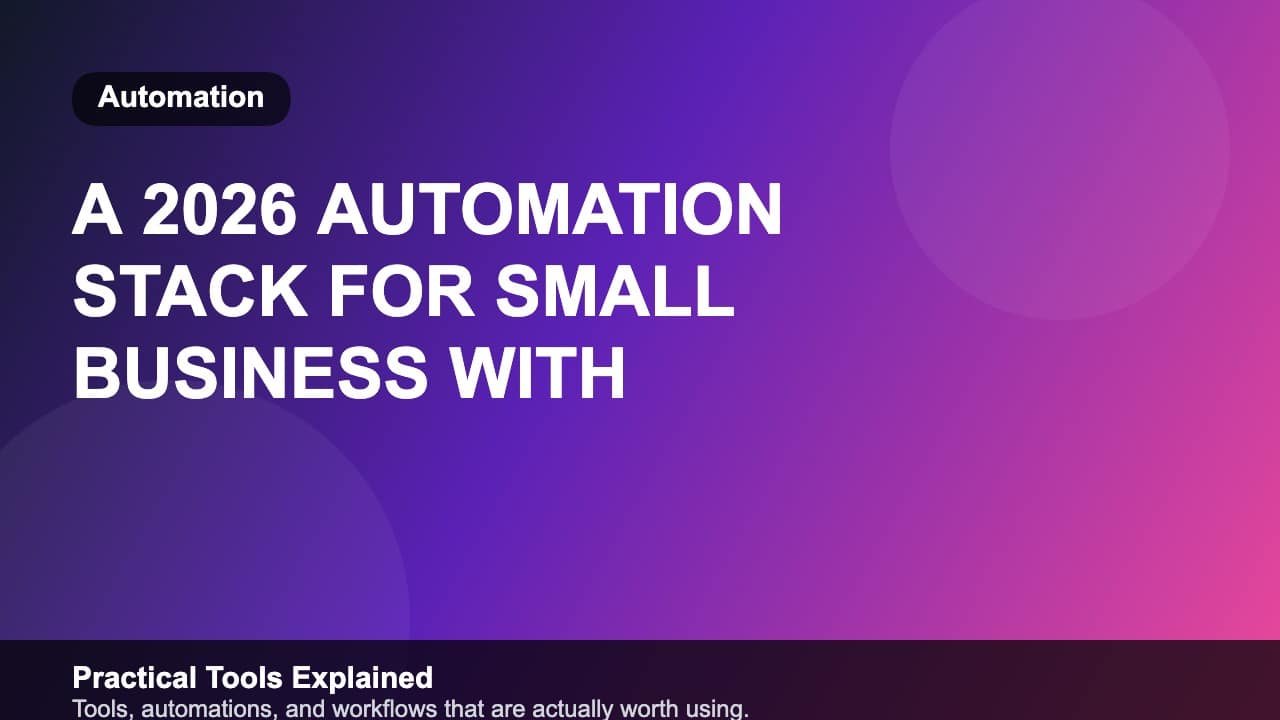
A concrete automation stack that links Shopify, Systeme.io, and Make so leads, orders, and emails move quietly in the background instead of on your to do list.
Everyone talks about automation like it is a switch you flip. In reality most small businesses end up with a tangle of half connected tools that no one fully understands. A client fills out a form, something kind of happens in your inbox, maybe a tag fires in your email tool, and you have no idea which part will break the next time you change something.
Some links in this guide are affiliate links. I only recommend tools I actually use or would use in my own business.
You do not need a giant enterprise stack to fix this. In 2026 a lean setup built around three tools can cover most of what you need. Shopify runs your store and takes payments. Systeme.io runs your funnels and core email. Make connects the pieces and handles the workflows that would otherwise live in a pile of sticky notes.
If you want a full overview of why this style of stack works, read best automation tools for small business 2026 and AI tools that can run parts of your business. This article is the practical blueprint for how to wire three of those tools together without overcomplicating the setup.
Start by deciding what absolutely has to happen every time a lead or order comes in. Forget tools for a moment and think in terms of events and outcomes. For most online businesses, the list looks something like this:
Shopify is great at capturing orders and basic customer details. Systeme.io is great at running the kind of funnels and email jobs that keep people moving. Make is great at listening for events in both places and making sure the right follow up happens every time.
One simple pattern is to treat Shopify as the home for transactions and Systeme.io as the home for relationship building. When an order comes in on Shopify, Make catches that event and sends the customer into the right Systeme.io campaign. When someone opts in from a Systeme.io funnel, Make can add them to a Shopify customer list or a segment, depending on how you want to track them.
For example, you might run a simple lead magnet funnel in Systeme.io that teaches the basics of your topic and leads into a starter product. The steps look like this:
All of this is easier if you think in terms of flows instead of features. If you have not mapped that out before, work through how to automate your business and your small business automation stack first. Those pieces will help you decide what to automate now and what to keep manual until you have more traffic and revenue.
You can layer in AI where it actually helps. Use AI tools to draft email copy, generate subject line ideas, and even sketch automation logic, but keep final decisions human. The stack you are building is meant to amplify a good business, not hide weak offers under a pile of fancy logic.
Over time you can add more flows: follow up with repeat buyers, re engagement campaigns for quiet subscribers, and internal alerts when someone moves through key milestones. Because you are using Make as the connective tissue, you can change pieces of the stack without starting from zero every time.
The end result is not a “fully automated business.” It is a business where the routine, repeatable work happens quietly in the background so you can spend more of your time on product, service, and strategy. Shopify sells, Systeme.io nurtures, and Make keeps them talking.
Two fixed-scope builds that fix both problems. No retainer to start. Live in under two weeks.